


The custom aluminum radiator process turns application data, measurements, drawings, or an existing sample into a production-ready cooling component. A reliable project normally moves through requirement definition, engineering review, quotation, design approval, production, inspection, and shipment.
For buyers, the most important task is to provide accurate inputs early and approve each technical checkpoint before manufacturing begins. This guide explains what to prepare, what a supplier should verify, and what output to expect at every stage.
Start with the application, heat load, installation envelope, coolant path, and operating environment.
Provide a 2D/3D drawing, a physical sample, or a complete measurement sheet with clear reference points.
Confirm core size, inlet and outlet positions, mounting points, filler neck, cap, drain, sensors, and fan arrangement.
Approve the drawing and commercial terms before tooling, prototyping, or batch production.
Define inspection, packaging, labeling, and documentation requirements in the purchase order.
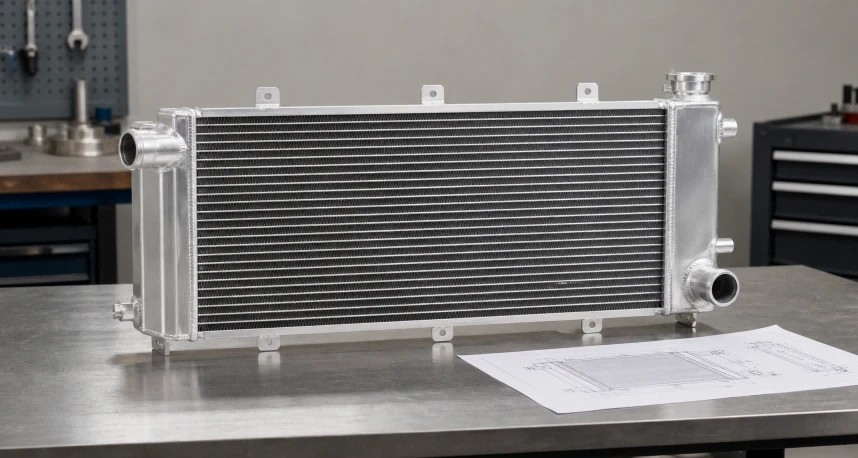
Custom radiator projects begin with application data and an agreed technical definition. Image is a generic AI-generated illustration.
Custom Aluminum Radiator Process at a Glance
A practical workflow should make responsibility visible. The buyer supplies the operating and installation information, while the manufacturer converts those inputs into a design that can be produced and inspected.
|
Step |
Buyer Provides |
Supplier Checks |
Expected Output |
|
1. Requirement definition |
Application, engine or equipment data, environment, quantity |
Cooling objective and project scope |
Requirement summary |
|
2. Technical input |
Drawing, sample, photos, measurements, connection details |
Missing dimensions and interface risks |
Complete input checklist |
|
3. Engineering review |
Responses to technical questions |
Fit, flow path, manufacturability, material and construction |
Proposed technical solution |
|
4. Quote and design |
Target quantity, Incoterm, destination, documentation needs |
Cost drivers, tooling, schedule and tolerances |
Quotation and approval drawing |
|
5. Sample approval |
Fitment and performance feedback |
Prototype inspection and change requests |
Approved sample or signed drawing |
|
6. Production |
Purchase order and approved specifications |
Material, process controls and assembly consistency |
Finished radiators |
|
7. Inspection |
Agreed acceptance criteria |
Dimensions, appearance, interfaces and leakage |
Inspection records as agreed |
|
8. Shipment |
Labels, packing marks and shipping instructions |
Protection, quantity and document consistency |
Packed goods and shipping documents |
When Should Buyers Choose a Custom Aluminum Radiator?
Customization is useful when a standard radiator cannot match the available space, hose routing, mounting points, cooling demand, or operating environment. It is also relevant for restoration projects, engine conversions, industrial equipment, generators, agricultural machinery, construction machinery, and low-volume specialty vehicles.
A custom part is not automatically the best option. Buyers should first check whether an existing design can be adapted, because a proven platform may reduce engineering work, tooling exposure, and approval time. Zuoer's aluminum radiator products and radiator product applications provide useful starting points for that comparison.
Step 1: Define the Application and Cooling Requirement
Begin with the machine or vehicle, not with the radiator alone. State the equipment type, engine model or power range, fuel type when relevant, operating duty, ambient conditions, coolant type, expected system pressure, and whether the radiator works alone or with other heat exchangers.
The supplier also needs to know the problem being solved. Common objectives include replacing an unavailable part, fitting a new engine into an existing chassis, improving durability in a demanding environment, or developing an OEM radiator for repeat orders.
A request such as "make the core thicker" is incomplete without airflow and packaging context. A thicker core can increase air-side resistance, while fan position, shrouding, frontal area, fin selection, coolant flow, and installation clearance all influence the final result.
The technical discussion should therefore cover the complete cooling system.
Step 2: Provide Drawings, Samples, or Clear Measurement Data
The best starting point is a dimensioned 2D drawing, supported by a 3D model when available. If no drawing exists, buyers can provide an original radiator, a carefully measured sketch, and photos taken from the front, rear, top, bottom, and both sides.
Measurements should use fixed reference points. Identify overall height, width, and thickness; core dimensions; tank dimensions; inlet and outlet diameters and center positions; mounting-hole locations; filler neck; drain; sensor ports; fan brackets; and any nearby parts that restrict space.
Mark units and tolerances clearly, and avoid estimating critical dimensions from a photo. For a fuller preparation list, see what information buyers should provide before ordering a custom radiator and this aluminum radiator size guide.
Minimum interface data to confirm
Maximum installation envelope and required clearance around the radiator.
Core width, height, thickness, and orientation.
Inlet, outlet, overflow, drain, and sensor connection specifications.
Mounting brackets, pins, holes, cushions, and attachment direction.
Filler neck, cap type, expansion tank connection, and vent arrangement.
Fan, shroud, condenser, charge-air cooler, oil cooler, or guard interfaces.
Step 3: Engineering Review and Feasibility Check
During engineering review, the manufacturer checks whether the requested geometry can be made consistently and whether the interfaces are sufficiently defined. This review may identify conflicting dimensions, inaccessible weld areas, unsupported brackets, unsuitable port positions, or tolerances that do not match the manufacturing method.
The supplier should also clarify the proposed construction: core configuration, tanks, headers, side plates, brackets, fittings, filler neck, cap, and any integrated cooler. Exact material grades, wall thicknesses, and fin or tube specifications should be documented only when they are part of the agreed design.
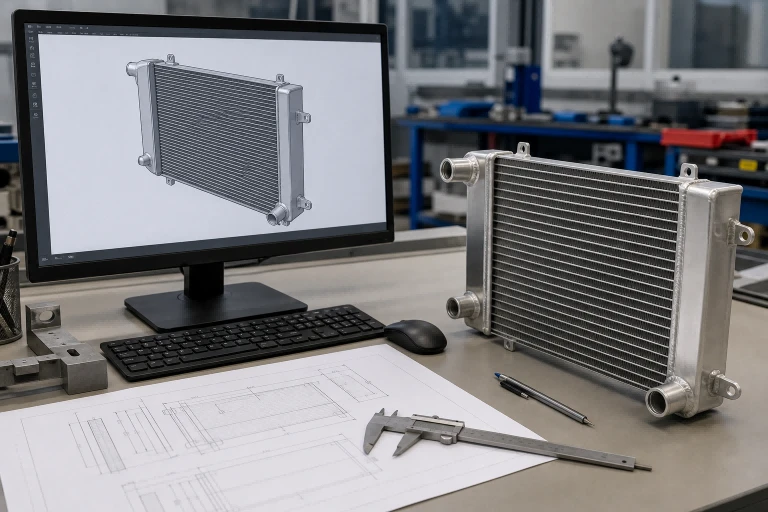
Engineering review converts measurements and application data into a manufacturable definition. Image is a generic AI-generated illustration.
At this stage, ask for a marked-up drawing or technical question list. A good review closes each open point before quotation approval, instead of allowing assumptions to move silently into production.
Step 4: Quotation and Design Confirmation
A useful quotation defines more than unit price. It should identify the quoted design, quantity tier, tooling or development charges if any, sample arrangement, packaging basis, trade term, payment terms, estimated schedule, quotation validity, and any exclusions.
Cost is normally affected by radiator size, core construction, fabrication complexity, special fittings, integrated coolers, surface requirements, inspection scope, order quantity, and packaging. Buyers should compare quotations on the same technical and commercial basis rather than comparing unit price alone.
Before approval, check the revision number and date on every drawing. Confirm which document controls production, how design changes will be authorized, and whether the supplier will issue a revised drawing after each accepted change.
Step 5: Prototype or Sample Approval
A prototype is especially valuable for a new installation, an incomplete original drawing, or a project with tight clearances. The sample allows the buyer to verify physical fit, connection positions, mounting alignment, fan and shroud clearance, filling access, hose routing, and serviceability.
Performance validation should use conditions that reflect the application. Record coolant temperatures, ambient temperature, load, fan operation, airflow restrictions, and test duration so feedback is comparable. A road test, bench test, or equipment trial can each be useful, but the method and acceptance criteria should be agreed in advance.
When a change is needed, send a numbered list tied to the drawing. The manufacturer should update the drawing and, when appropriate, the sample before the buyer authorizes batch production.
Step 6: Production, Brazing, Welding, and Assembly
Production generally includes material preparation, core assembly, joining, tank and bracket fabrication, welding, cleaning, final assembly, and inspection. The exact route depends on the radiator design and the manufacturer's equipment, so buyers should avoid assuming that every aluminum radiator uses the same process.
Brazing and welding have different roles. Brazing joins parts by melting a filler metal below the melting point of the base components, while welding locally melts the base material.
Joint design, surface condition, material compatibility, atmosphere, and process control all affect the result, as explained by TWI's brazing overview and the European Aluminium brazing guide.
For repeat orders, the approved drawing should remain the production reference. Revision control matters because a small change in a bracket, port angle, or mounting location can determine whether the radiator installs correctly.
Step 7: Quality Inspection Before Shipment
Inspection should match the risks in the application and the purchase specification. A typical final check may cover overall dimensions, mounting points, port positions and threads, weld appearance, fin damage, cleanliness, accessories, labeling, and packaging readiness.
Leak or pressure testing verifies the integrity of the coolant circuit. The method, pressure, hold time, medium, leakage limit, and sampling plan should be agreed for the specific project.
Radiator testing may use pressure decay or another configured leak-test approach. Cincinnati Test Systems' radiator testing case study shows why the test setup and acceptance specification must suit the component and production environment.
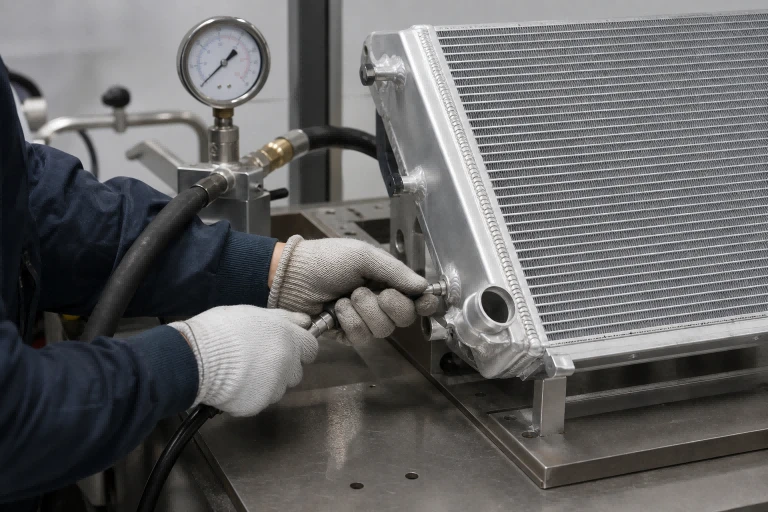
Testing requirements should be written into the approved specification or purchase order. Image is a generic AI-generated illustration.
Buyers that require inspection reports, material documents, photos, third-party inspection, or serialized records should state this before quotation. Documentation added after production can be unavailable or costly to reconstruct.
Step 8: Packaging, Delivery, and After-Sales Confirmation
Aluminum radiators need protection against crushed fins, bent brackets, impact to filler necks and ports, moisture, and movement inside the carton or crate. Caps or plugs should protect openings, and packing supports should load the stronger structural areas instead of the core face.
Confirm carton marks, product labels, barcode needs, accessory packing, pallet requirements, and any importer-specific documentation before shipment. The packing method should reflect shipment mode, handling conditions, order size, and the destination's requirements.
After receipt, inspect the packaging before unpacking, photograph any external damage, verify quantity and labels, and check key interfaces. For repeat orders, report installation or field feedback against the drawing revision and batch reference so the supplier can trace the issue efficiently.
Custom Radiator Quotation Checklist
Sending a complete request reduces back-and-forth and helps suppliers quote the same scope. Use this checklist as an RFQ cover sheet:
|
Category |
Information to Provide |
|
Application |
Vehicle or equipment type, model, engine, duty, and operating environment |
|
Cooling system |
Coolant, system pressure, heat-load information if available, fan and airflow arrangement |
|
Dimensions |
Overall size, core size, installation envelope, clearances, units, and tolerances |
|
Connections |
Inlet/outlet positions and diameters, filler neck, drain, sensors, vents, and integrated coolers |
|
Mounting |
Hole centers, brackets, pins, rubber mounts, fan/shroud/condenser interfaces |
|
References |
2D/3D drawing, original sample, part number, and labeled photos |
|
Commercial |
Prototype quantity, annual or batch quantity, destination, Incoterm, target timing, and packing needs |
|
Quality |
Acceptance criteria, reports, traceability, labeling, and third-party inspection requirements |
Common Mistakes That Delay Custom Radiator Projects
Using only overall dimensions. A radiator may fit the outer space but still fail to install because a hose neck, bracket, cap, drain, fan, or nearby component conflicts with the chassis.
Sending photos without scale or reference points. Photos help orientation, but perspective distortion makes them unreliable for critical dimensions. Add a drawing and identify the measurement origins.
Changing the design after production approval. Late changes can affect materials, tooling, price, and schedule. Freeze the drawing revision before production and use a documented change process.
Leaving test and packaging requirements until the end. Inspection records, special labels, plugs, pallets, or export packing can influence quotation and production planning. Include them in the RFQ.
Assuming fitment proves cooling performance. Physical installation is only one approval step. Validate performance under representative load and environmental conditions.
How to Work With an Aluminum Radiator Manufacturer
Choose a supplier that asks detailed technical questions, controls drawing revisions, explains its proposed construction, and agrees on inspection criteria. Product range, relevant application experience, communication quality, sample handling, and the ability to support repeat orders are more informative than a price list by itself.
When assessing an aluminum radiator manufacturer in China, review whether its available products and processes fit your project rather than relying on broad capability statements. This guide on how to find a suitable car radiator manufacturer in China provides additional supplier-screening points.
Keep one controlled technical file for each part number: the approved drawing, revision history, sample approval, inspection requirements, packaging specification, and agreed commercial conditions. That record becomes the reference for reorders and future changes.
Frequently Asked Questions
What information is required for a custom aluminum radiator quote?
Provide the application, drawing or sample, dimensions, connections, mounting details, quantity, destination, testing, and packaging requirements.
Can a radiator be customized from an old sample?
Yes, but the buyer should identify required changes and confirm critical dimensions because an old sample may be worn or modified.
Is a 3D model required?
No. A dimensioned 2D drawing or a measured sample can work, although a 3D model helps with complex interfaces.
Should buyers order a prototype before batch production?
A prototype is advisable for new designs, tight installation spaces, incomplete drawings, or projects requiring fit and performance validation.
How is a custom radiator checked for leaks?
The method and acceptance limits vary; agree on test pressure, medium, hold time, leakage limit, and sampling before production.
What causes most custom radiator delays?
Missing dimensions, unclear interfaces, late design changes, and undefined inspection or packaging requirements are common causes.
To discuss a project with Yangzhou Zuoer Radiator Co., Ltd., send your radiator specifications, drawings, sample photos, application details, expected quantity, and delivery destination. The engineering review can then focus on the actual fit, construction, inspection, and commercial requirements of your custom radiator.


