
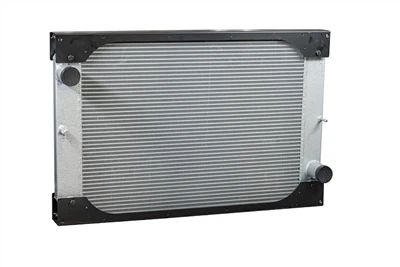
Aluminum Condenser
Your Leading Yangzhou Zuoer Radiator Co., Ltd. Supplier
Yangzhou Zuoer Radiator Co., Ltd. is located in the Automobile lightweight Industrial Park of Yangzhou Economic Development Zone, Jiangsu Province, China. It is a professional enterprise specializing in the design and manufacture of automotive construction machinery, agricultural machinery, generator sets, air compressors and other heat dissipation systems, water radiators, oil radiators, intercoolers and new energy vehicle radiators.
Why Choose Us
High quality
The company has advanced quality assurance system ensures the continuous and stable product quality and meets the needs of all kinds of customers.
Rich experience
Our company has more than 20 years of production work experience.
Advanced equipment
The company has a first-class professional production line of aluminum radiator products, with all kinds of radiator products.
Technical support
The company has a mature and stable radiator product research and development team.

Real Factory

In systems involving heat transfer, a condenser is a heat exchanger used to condense a gaseous substance into a liquid state through cooling. In doing so, the latent heat is released by the substance and transferred to the surrounding environment. Condensers are used for efficient heat rejection in many industrial systems. Condensers can be made according to numerous designs and come in many sizes ranging from rather small (hand-held) to very large (industrial-scale units used in plant processes). For example, a refrigerator uses a condenser to get rid of heat extracted from the interior of the unit to the outside air.
Condensers are used in air conditioning, industrial chemical processes such as distillation, steam power plants, and other heat-exchange systems. The use of cooling water or surrounding air as the coolant is common in many condensers.
Benefits of Aluminum Condenser
One of the most significant advantages of using aluminum condenser header pipes is their exceptional heat transfer efficiency. Aluminum is renowned for its high thermal conductivity, which means it can rapidly and effectively transfer heat between the refrigerant vapor and the ambient air. This results in improved cooling performance, ensuring that the system operates at optimal efficiency.
Aluminum is a lightweight metal compared to traditional materials such as copper. This characteristic significantly reduces the overall weight of the condenser unit, making it easier to handle during installation and maintenance. Moreover, the reduced weight can lead to cost savings in terms of transportation and handling expenses.
Another noteworthy advantage of aluminum condenser header pipes is their natural corrosion resistance. When exposed to the atmosphere, aluminum forms a thin oxide layer on its surface, which acts as a protective barrier against corrosion and rust. This inherent resistance to corrosion ensures that the header pipe maintains its structural integrity over an extended period, enhancing the system’s longevity.
Aluminum is generally more cost-effective than other metals like copper, which is commonly used in condenser coils. The lower cost of aluminum makes it an attractive option, especially for larger cooling systems that require a considerable amount of material. This cost-effectiveness can translate into more affordable air conditioning and refrigeration solutions for consumers and businesses alike.
As the world shifts toward sustainable practices, the use of aluminum condenser header pipes aligns with environmental conservation efforts. Aluminum is highly recyclable, and its recycling process requires significantly less energy compared to producing new aluminum from raw materials. This recyclability reduces the environmental impact of HVAC systems, making them more eco-friendly.
●Air-cooled condensers
Air-cooled condensers operate by using the surrounding air to remove heat from vapour or steam inside the tubes. High-temperature steam or vapour enters the tubes, transferring heat to the tube walls and, subsequently, to the air through natural or forced convection. Natural convection utilises atmospheric air to cool the vapour, while forced convection employs fans to enhance heat dissipation. Air-cooled condensers are typically made of materials like iron, copper, and steel, and they are commonly used in domestic refrigeration systems, such as home refrigerators.
Natural convection condenser
A natural convection condenser relies on the principle of buoyancy-driven flow, where warmer air rises and cooler air sinks. In this type of condenser, the transfer of heat occurs passively, without the use of fans or external mechanisms. It is commonly used in smaller cooling applications and is energy-efficient but may have limited heat transfer capacity.
Forced convection condenser
A forced convection condenser employs mechanical fans or pumps to circulate air or another fluid over the condenser coils actively. This enhanced air movement accelerates heat transfer, making forced convection condensers more suitable for larger cooling systems, such as air conditioning units and refrigeration systems.
●Water-cooled condensers
Water-cooled condensers employ water as a cooling medium and are used in larger industrial refrigeration systems. They are particularly suited for applications with high refrigerant flow rates. Within this category are three sub-types: Tube in Tube, Shell & Coil, and Shell & Tube.
Tube in tube condenser
In the Tube in Tube condenser, water flows through the inner tube while the refrigerant flows through the circular space between the two tubes, facilitating efficient heat transfer.
Shell & coil condenser
The Shell & Coil-type condenser comprises a welded steel shell with a coil of finned tubing through which water flows, and the refrigerant circulates within the shell.
Shell & tube-type condenser
In the Shell & Tube-type condenser, straight tubes and integral fins are enclosed within a cylindrical shell, allowing for efficient heat exchange between the refrigerant and water. These water-cooled condensers are commonly used in central air conditioning plants and other industrial settings with high cooling demands.
●Evaporative-type condensers
Evaporative-type condensers incorporate both air and water-cooling mechanisms. Water is pumped from a sump to a spray header, where it is sprayed over the condenser coil. Simultaneously, a fan draws air from the bottom of the condenser and expels it from the top. As the spray water comes into contact with the condenser tubes, it evaporates into the airstream. This process provides cooling by absorbing heat from the refrigerant, causing it to condense from a gaseous to a liquid state. Evaporative condensers are known for their energy efficiency and find applications where minimising power consumption is essential.
Application of Aluminum Condenser


Automotive
Condensers designed for use in automotive or vehicular air conditioning systems (e.g. Cars, planes, trains).
Building
Condensers used to provide central air conditioning for buildings. They can be mounted outdoors, either on the ground or rooftop.
Steam power turbine
Surface condensers used in power generation facilities such as nuclear power plants to condense turbine exhaust steam into water.
HVAC systems
Heating, Ventilation, and Air Conditioning (HVAC) systems rely heavily on condensers to regulate indoor temperature and humidity. In these systems, a refrigerant absorbs heat from indoor air, undergoes compression, and then releases heat in the condenser to the external environment. This process is vital for maintaining comfortable living and working conditions in residential, commercial, and industrial buildings.
Distillation processes
Condensers are integral components in distillation processes, where mixtures of liquids with different boiling points are separated. As vapor rises through a distillation column, it encounters a condenser where it is cooled and condensed back into a liquid. This allows for the collection of purified substances, making condensers essential in industries such as petrochemicals, beverages, and pharmaceuticals.
Laboratory applications
In laboratories, condensers are frequently used in various experimental setups. For example, in chemistry, reflux condensers are employed to prevent the loss of volatile substances during reactions by returning evaporated solvents back to the reaction vessel. This ensures efficient use of chemicals and minimizes waste.
Geothermal power plants
Geothermal power plants harness the Earth’s internal heat to generate electricity. Steam, produced by tapping into underground reservoirs of hot water or steam, is directed through turbines to generate power. Condensers are then used to convert the steam back into water for re-injection into the Earth, completing the geothermal energy cycle.
Components of Aluminum Condenser
Coil
There’s a coil inside of condenser units. Know as the condenser coil, it acts like a heat exchanger.
As hot refrigerant is forced through the condenser coil, heat will be released. And because the condenser coil – as well as the entire condenser unit – is located outdoors, the heat will escape your homes.
Compressor
Condenser units contain a compressor as well.
The compressor is often referred to as the heart of the condenser unit. Without it, the condenser unit won’t be able to perform its function by removing heat from the refrigerant.
The compressor is a device that’s designed to compress refrigerant.
Before entering the condenser coil, refrigerant must go through the compressor. The compressor will force the refrigerant molecules closer together, essentially pressurizing them. This process makes the refrigerant hotter so that it can release more heat.
Blower
Another part of a condenser unit is the blower. The blower is essentially an electrical motor.
When running your home’s AC system, it will spin so that heat can be released from the refrigerant. If the blower fails, the refrigerant may remain hot. The condenser coil won’t be able to release heat from it, resulting in the hot refrigerant going back into your home.
Fan
The blower works in conjunction with a fan. All condenser units have a fan, which is typically connected to a blower.
As the blower spins, so will the blades on the fan to which it’s connected. The fan will then move air over the condenser unit. You can typically see and hear the fan inside of the condenser unit when it’s running.
How to Maintain Aluminum Condensertitle
Coil cleaning
Regularly clean the condenser coils to remove dirt and debris, which can hinder heat transfer and reduce efficiency.
Lubrication
Ensure that all moving parts, such as fan motors and bearings, are well-lubricated to reduce friction and extend the lifespan of components.
Electrical component inspection
Inspect electrical connections, controls, and wiring for signs of wear or corrosion. Tighten loose connections to prevent electrical issues.
The concept behind condensers is heat transfer. That is, the thermodynamic principle describing how heat always moves from warmer to cooler environments.
Three different phases happen in condenser. The first phase is called the desuperheating. The vapor entering in the condenser is superheated and super pressurized. Desuperheating means to eject the heat from the vapor and turns it into liquid, is the initial cooling process.
The second phase is condensation. Once all refrigerant superheat has been rejected, the actual process of condensation may begin. Condensation involves the transformation of the gaseous refrigerant into its liquid state.
The third and last phase is a sub-cooling state. The sub-cooling state is there to be sure that not even rising temperatures can bring the liquid refrigerant into vapor again.

Consider While Designing an Air Cooled Condenser
Dry Bulb temperature
The design of an air-cooled condenser is primarily based on dry bulb temperature at the plant location. Since the cooling medium for steam is air, a higher ambient temperature may lead to a lower heat transfer coefficient, thus a larger sized condenser required. A smaller condenser is essential at lower temperatures. An air-cooled condenser is designed for a temperature range of 2 to 5 % higher than that of the highest ambient temperature at that location.
01
Air velocity
A higher air velocity may give a larger heat transfer coefficient, thus the condenser size will be smaller. While it might need a supply of more power of fan which also leads to increase in pressure drop. Thus, it is necessary to balance the range of power requirement and overall heat transfer coefficient.
02
Tube arrangement
The tubes can be arranged in an inline and staggered manner. The inline tube arrangement gives lower pressure drop and poor heat transfer as the flow tends to be channeled into a high-velocity region in the center of the lanes between the tube rows. While staggered tubes produce good mixing of the flow over the tube banks but give a higher pressure drop.
03
Pitch
As the distance between the successive tube size increases, the pressure drop inside the fin side decreases and also due to less obstruction. On the other hand, a higher pitch occupies more space. Thus, it is necessary to maintain the balance between space restriction and pressure drop.
04
How to Choose Perfect Condensing Unit
Condensing unit is one of the most important part of a refrigeration system. The main function of the units is to regulate the heat of the system by condensing a substance to its liquid state from the gaseous state. Selection of condensing units are an important process. Their main purpose is the elimination of heat extracted from the refrigeration systems interiors by sending it outside. It is always viable to select the units after a careful analysis of available space. They come in different sizes and designs depending on their applications. Many Condensing units are made of metal plates, which are not based of available standard sizes. Space is an important factor as the compressors in the units available are of different heights and it can lead to problems at the time of assembly.
The capacity of the condensing unit is another important factor to be considered. Appropriately sized units will ensure technical reliability. The sizing accuracy of the units will have a direct impact on the temperature, condensation, evaporation etc. While selecting the condensing units, it is always advisable to consider the evaporation level at which the compressor is allowed to work with. It is different for every compressor and condensing unit.
Power supply is another crucial point to be considered while choosing the condensing units. Be sure to select the units that are equipped with same frequency of power supply and voltage. Starting torque of the condensing units are another point to be analyzed. If the compressor in the condensing unit is using high starting torque, special attention is to be paid to the expansion valves of the units.
It is a professional enterprise specializing in the design and manufacture of automotive construction machinery, agricultural machinery, generator sets, air compressors and other heat dissipation systems, water radiators, oil radiators, intercoolers and new energy vehicle radiators.


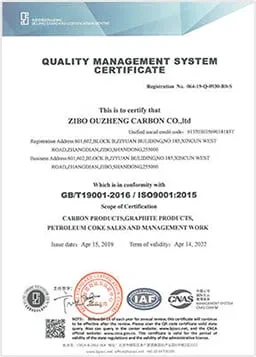
Our Certificate