


Data, technology, export depth, buyer controls, and the practical advantages of Chinese supply
By Tania | Senior Customer Advisor, Yangzhou Zuoer Radiator Co., Ltd. | Data reviewed August 2026
China has one of the world's strongest supply bases for aluminum automotive radiators. Its advantage comes from automotive manufacturing scale, aluminum conversion capacity, specialized component clusters, broad model coverage, and export experience. For overseas buyers, the opportunity is strong when specifications and quality controls are clearly defined.
I'm Tania, a senior customer advisor at Yangzhou Zuoer Radiator Co., Ltd. This report combines current public industry data, technical literature, trade statistics, and factory-side observations. It focuses on passenger-car and light-vehicle aluminum radiators, while noting where public statistics include other radiator types or parts.
Executive findings
China produced 34.53 million motor vehicles in 2025, about 35.8% of the 96.38 million vehicles recorded globally by OICA.
The same production base supports mature tooling, aluminum forming, brazing, welding, testing, packaging, and automotive-component logistics.
China exported USD 2.35 billion of motor-vehicle radiators and parts under HS 870891 in 2024, showing broad global market reach.
Chinese factories cover aluminum-plastic replacement radiators, all-aluminum performance products, custom models, cores, and related heat exchangers.
The real advantage is a cost-capability combination. A low quotation without a controlled drawing, material definition, and test plan is not the same advantage.
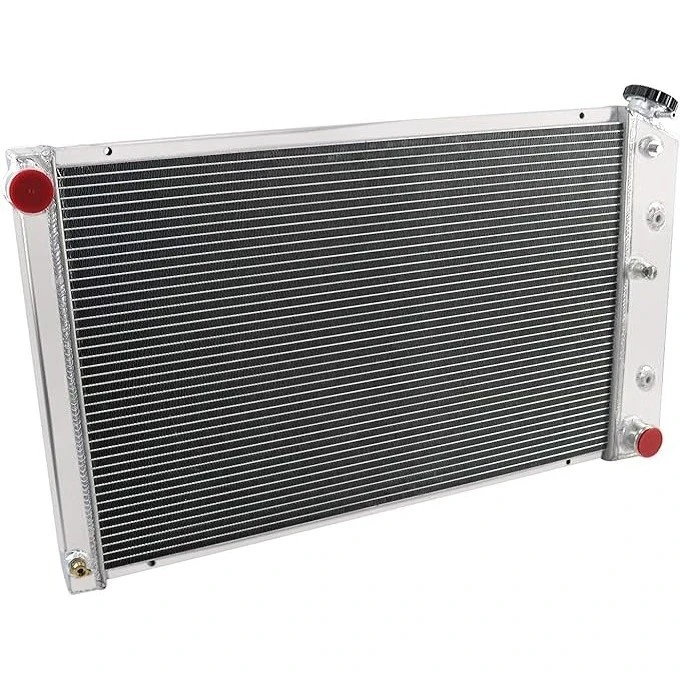
A real all-aluminum automotive radiator from the Zuoer product range. Source page.
Report scope: what the data can and cannot prove
There is no single public, audited national series that isolates only all-aluminum passenger-car radiator output in China. Commercial market reports often publish large unit estimates, but their product boundaries may mix complete radiators, radiator parts, industrial units, and different materials. I do not treat those figures as directly comparable.
This report therefore uses four observable indicators: national vehicle production, aluminum availability, HS 870891 radiator trade, and documented manufacturing technology. Together they describe production depth more reliably than one unsupported market-size number. Company-specific capacity is identified separately as a supplier statement, not a national statistic.
|
Indicator |
Latest public figure |
What it indicates |
Important boundary |
|
Motor vehicle production |
34.53 million units in 2025 |
Large domestic OEM and component ecosystem |
All vehicle types, not radiator output |
|
NEV production |
16.63 million units in 2025 |
Rapid thermal-management development |
NEVs use varied cooling architectures |
|
HS 870891 exports |
USD 2.35 billion in 2024 |
Established export channels and market coverage |
Radiators and parts; all materials and vehicle segments |
|
Primary aluminum |
41.6 million metric tons in 2023 |
Deep upstream material and conversion base |
National aluminum output, not radiator-grade sheet alone |
Sources: OICA 2025 production table, World Bank WITS/UN Comtrade, and USGS China mineral-industry data.
Production status: a large industrial base with export depth
Vehicle production keeps the radiator ecosystem active
The OICA 2025 production table records 34,530,738 vehicles produced in China out of 96,383,650 worldwide. That scale supports repeated demand for heat exchangers, tooling, fixtures, test equipment, packaging, and replacement parts. It also gives component factories frequent exposure to new platforms and changing cooling requirements.
New-energy vehicle production reached 16.626 million units in 2025. This does not mean conventional engine radiators disappear immediately. China now serves a mixed market containing internal-combustion vehicles, hybrids, commercial vehicles, exported platforms, and a huge aftermarket. Factories increasingly apply related skills to battery coolers, condensers, oil coolers, intercoolers, and integrated thermal systems.
Aluminum availability supports a broad conversion chain
A 2026 USGS review of China's mineral industries reports 41.6 million metric tons of primary aluminum production in 2023, equal to 59% of the world total. Radiator quality still depends on the correct alloy, temper, cladding, tube, fin, and supplier control. National metal output alone does not guarantee radiator-grade material.
The practical advantage is industrial proximity. Chinese radiator factories can source aluminum sheet, tubes, fins, header plates, tanks, filler necks, brackets, caps, cartons, pallets, and tooling from an established manufacturing network. That network can reduce coordination time and make both standard and custom programs more commercially workable.
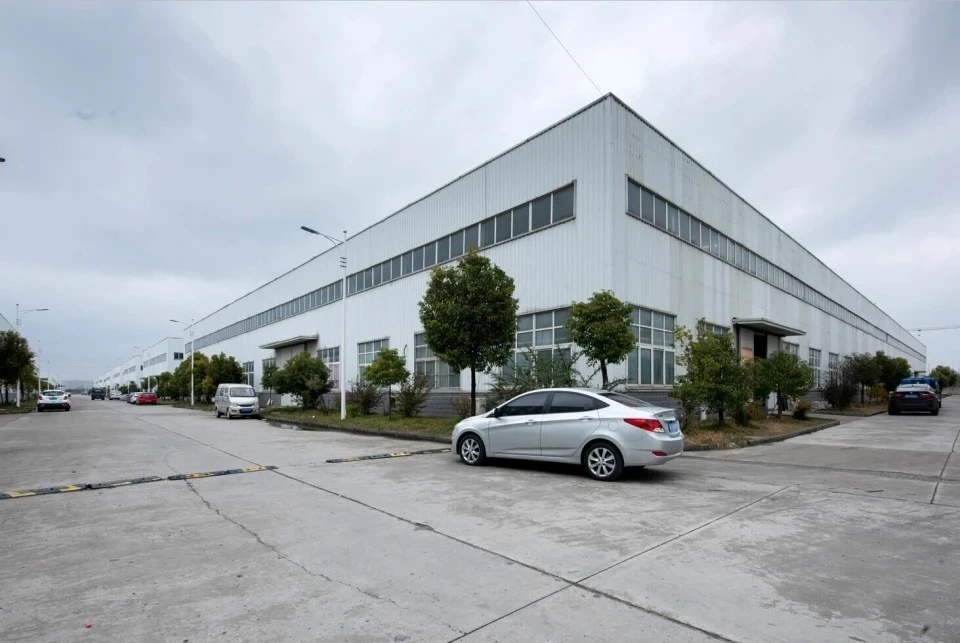
The Zuoer radiator manufacturing facility in Yangzhou, Jiangsu Province. Source page.
Export data shows broad market reach
World Bank WITS data based on UN Comtrade records USD 2.348 billion and 263.825 million kilograms of Chinese exports under HS 870891 in 2024. The leading destinations included the United States, Mexico, Japan, Russia, Poland, Germany, and Brazil.
The code covers radiators and parts for motor vehicles, not only complete aluminum car radiators. Even with that limitation, the geographic spread demonstrates mature customs classification, freight handling, multilingual documentation, and distributor relationships. These capabilities matter because a technically acceptable radiator still fails commercially if labeling, cartons, palletization, or documents are wrong.
What Chinese factories are producing
The China automotive radiator industry is not one uniform segment. Factories range from large thermal-system groups serving OEM programs to specialized exporters focused on independent aftermarket models. Others concentrate on performance upgrades, small custom batches, heavy-duty applications, or radiator cores.
Aluminum-plastic radiators for high-volume replacement markets and model-specific fitment.
Brazed all-aluminum radiators for performance, off-road, racing, classic-car, and custom applications.
Truck, agricultural, construction-equipment, generator, and industrial cooling products using related heat-exchanger processes.
Radiator cores, charge-air coolers, oil coolers, condensers, and other components that share suppliers and production equipment.
Low-volume development from samples or drawings, followed by tooling, validation, and controlled batch production.
Buyers should not treat 'aluminum radiator' as a complete specification. A quotation must identify core construction, tube and fin details, tank material, header plates, interfaces, welding or brazing method, finish, accessories, test requirements, and packaging. China offers many configuration choices, which is valuable only when those choices are controlled.
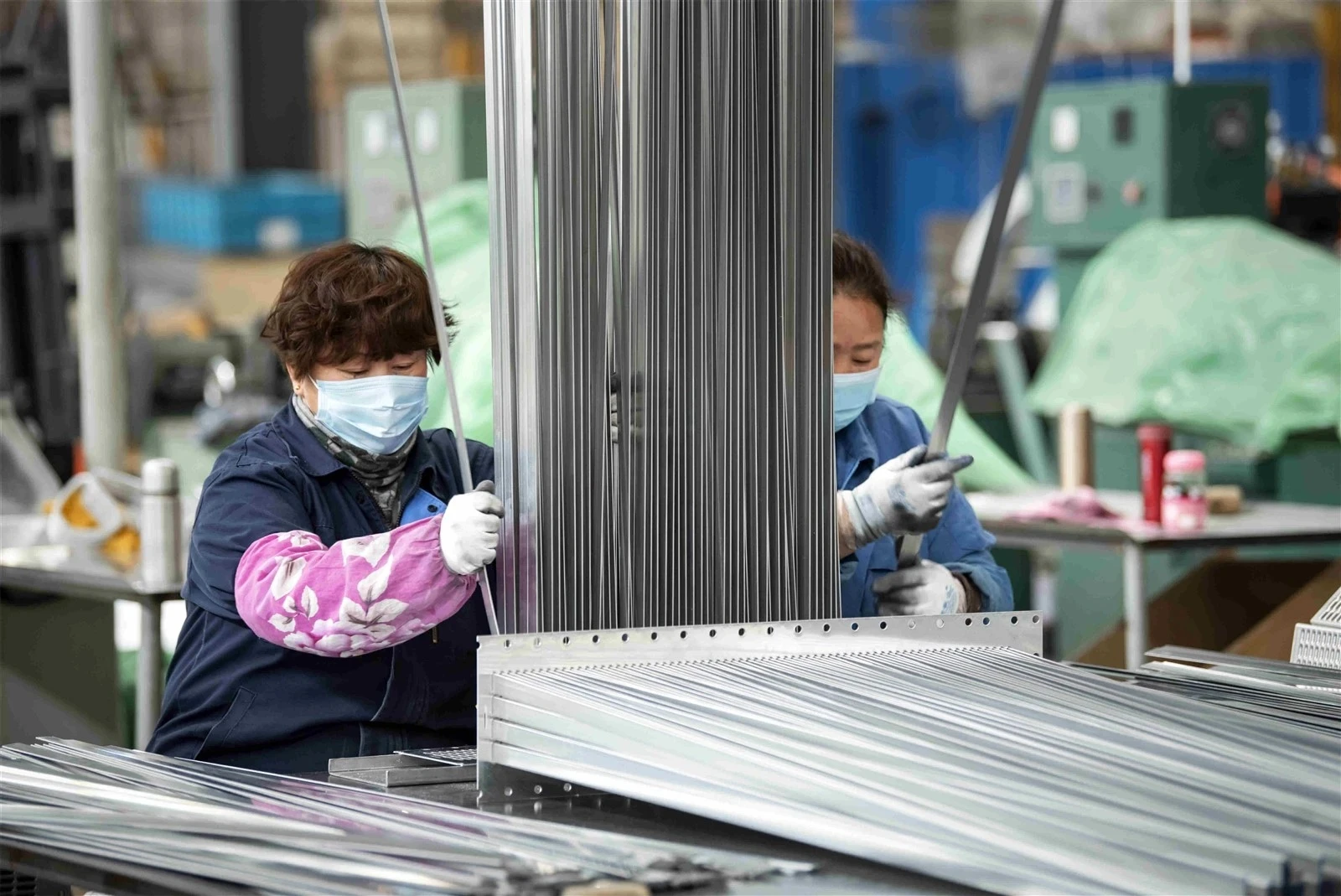
Real aluminum radiator core assembly at the Zuoer production facility. Source page.
How aluminum automotive radiators are manufactured in China
Chinese factories use several process routes according to radiator design and volume. A peer-reviewed Materials study on controlled-atmosphere brazing notes that AA3003 is widely used for automotive heat exchangers and that CAB with non-corrosive flux is a widely used production process. All-aluminum custom units may also require extensive tank and bracket welding.
|
Production stage |
Typical activity |
Buyer control point |
|
Engineering |
Confirm fitment, thermal duty, construction, interfaces, and drawing revision. |
Approve one controlled drawing and deviation list. |
|
Material preparation |
Form tubes, fins, headers, tanks, brackets, and connections. |
Define material and critical dimensions in writing. |
|
Core assembly |
Stack tubes and fins in fixtures; install headers and side plates. |
Control alignment, fin damage, cleanliness, and fixture condition. |
|
Joining |
Use CAB, welding, or mechanical assembly according to design. |
Define process route and inspect critical joints. |
|
Testing |
Check dimensions, workmanship, leakage, pressure, and required performance. |
Specify method, pressure, duration, limits, and records. |
|
Packing |
Protect fins, ports, accessories, labels, cartons, and pallets. |
Approve packaging before production release. |
Factory-process summary for buyer evaluation; exact methods depend on radiator design and application.
Factory note: the joining process is only one part of quality. Tube insertion, header fit, furnace profile, weld penetration, cleanliness, pressure-test setup, handling, and packaging can all affect leakage or early failure. A mature supplier controls the complete route and links records to the drawing revision and production batch.
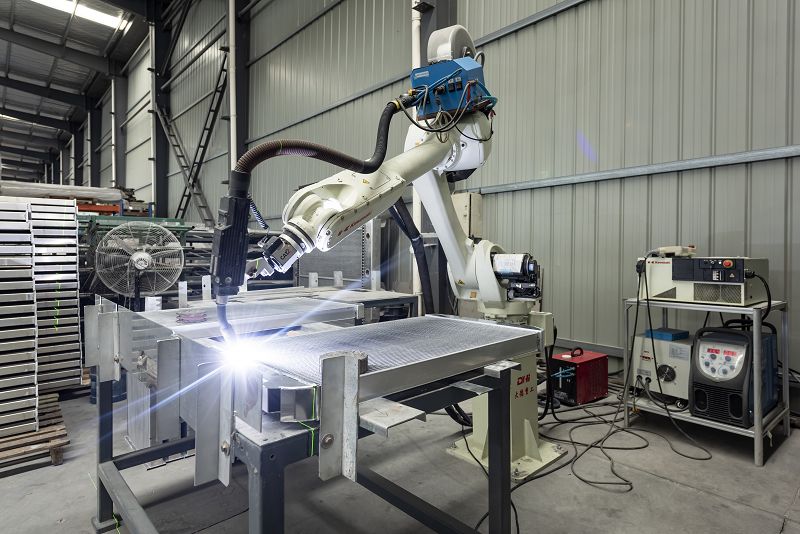
Automated welding equipment operating in the Zuoer radiator workshop. Source page.
Why China offers a strong supply advantage
|
Chinese supply strength |
Buyer benefit |
Condition for realizing the benefit |
|
Large automotive base |
Wide model knowledge and continued component demand. |
Supplier must prove experience with the required vehicle or application. |
|
Dense industrial network |
Faster access to materials, tooling, accessories, and packaging. |
Approved materials and sub-suppliers must remain controlled. |
|
Multiple factory tiers |
Options for OEM, aftermarket, performance, and custom programs. |
Select by capability and controls, not by marketplace badge alone. |
|
Manufacturing scale |
Competitive conversion cost and workable batch planning. |
Compare quotations against identical technical and commercial scope. |
|
Export experience |
Established documentation, consolidation, and destination handling. |
Confirm labels, Incoterms, documents, pallet limits, and claim process. |
Buyer-value matrix based on industry research and recurring sourcing discussions.
A dense supplier ecosystem
China's advantage is broader than low labor cost. Radiator production connects aluminum mills and processors with tube makers, fin equipment, stamping, CNC machining, welding, brazing furnaces, leak testers, surface finishing, tooling, cartons, pallets, and freight services. A concentrated ecosystem lets factories solve development and supply issues without rebuilding the entire chain.
Faster model development and customization
Many Chinese manufacturers serve both catalogue and project business. They can reverse-engineer a verified sample, review a buyer drawing, modify inlet positions, change brackets, adapt filler necks, or develop a thicker core when the engineering case supports it. Development speed still depends on complete inputs, sample availability, tooling complexity, and validation requirements.
Cost efficiency from scale and specialization
A competitive Chinese price can come from repeated production, shared tooling platforms, specialized labor, local material conversion, and supplier competition. The best purchasing result is not necessarily the lowest unit price. It is the lowest controlled total cost after fitment, testing, packaging, freight, warranty handling, and replacement risk are included.
Export execution for varied markets
Chinese suppliers regularly serve North America, Latin America, Europe, the Middle East, Asia, Africa, and Oceania. This creates practical experience with mixed model lists, private labels, neutral packaging, pallet optimization, container loading, and shipping documents. Buyers should still verify destination-specific legal, labeling, and customs requirements for every order.
Quality capability is broad, but supplier levels are not equal
China can supply high-quality automotive radiators, but Chinese factories do not all operate at the same level. The market includes advanced OEM-oriented plants, capable export factories, general aftermarket producers, trading companies, and low-control workshops. A strong national supply base does not remove the need for supplier qualification.
Verify the legal manufacturer, production site, equipment, process route, and certificate scope.
Approve a drawing with dimensions, interfaces, material notes, construction, finish, and revision control.
Use sample validation for new designs, new suppliers, changed specifications, or high-consequence applications.
Define leak-test method, medium, pressure or vacuum, duration, acceptance limit, retest rule, and records.
Approve inspection, labeling, packaging, palletization, and shipment-release evidence before mass production.
Put change approval, warranty evidence, corrective action, replacement, freight, and claim timing in the order terms.
An unusually low quotation deserves a scope review. The difference may come from tube or fin specifications, core layout, tank construction, accessories, process time, testing, packaging, documentation, or after-sales responsibility. I recommend a line-by-line comparison before a buyer treats prices as equivalent.
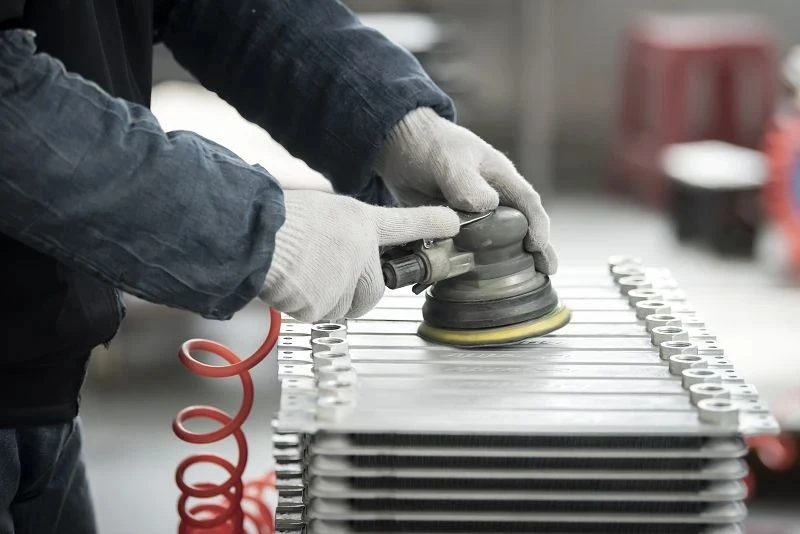
Real finishing work on aluminum radiator assemblies in the Zuoer factory. Source page.
Factory perspective from Zuoer Radiator
At Zuoer, I use China's broad supply base as a starting point, not as proof that every order is automatically correct. My role is to help overseas buyers turn an application, old sample, or drawing into a controlled technical and commercial package before production begins.
Our website states that the company has annual capacity of more than 300,000 sets across its radiator product range. This is a Zuoer capacity statement, not a national automotive-radiator statistic. The stated range covers automotive, construction machinery, agricultural machinery, generator, air-compressor, and new-energy cooling products.
Buyers can review our aluminum radiator product range, see the radiator manufacturing facility in China, and compare automotive and industrial cooling applications. Project-specific capability must still be confirmed against the actual drawing, quantity, test plan, and target market.
Outlook for 2026-2030
China's aluminum automotive radiator sector is likely to remain globally important, but its product mix will keep changing. Conventional vehicle and aftermarket demand will coexist with hybrid and electric thermal-management programs. Factories that combine established heat-exchanger production with engineering, documentation, traceability, and flexible development are best positioned.
More mixed thermal systems combining water cooling, oil cooling, charge-air cooling, condensers, and battery or power-electronics loops.
Continued demand for replacement radiators across a large and aging global vehicle fleet.
Greater pressure for lightweight construction, corrosion control, recycled material management, and energy-efficient production.
More buyer audits of material traceability, process records, packaging sustainability, and supplier continuity.
Ongoing price competition, making technical scope comparison more important rather than less important.
China's strongest long-term advantage is its ability to connect material supply, engineering, component production, customization, and export execution in one manufacturing ecosystem. That advantage is durable when suppliers compete through process capability and buyer control, not through unsustainably low quotations.
When sourcing from China makes the most sense
|
Buyer profile |
Why China can fit |
What to prepare |
|
Aftermarket distributor |
Broad model coverage, mixed orders, private labels, and export packing. |
Vehicle list, OE references, annual demand, carton and label rules. |
|
Performance brand |
All-aluminum construction, custom cores, brackets, ports, and finishes. |
Drawing or sample, duty conditions, fitment checks, validation plan. |
|
OEM or project buyer |
Engineering support, tooling, controlled production, and scalable batches. |
Technical specification, PPAP or document needs, test and change controls. |
|
Legacy or special vehicle buyer |
Reverse engineering and low-to-medium-volume customization. |
Verified sample, dimensions, photos, installation interfaces, quantity. |
Practical sourcing-fit summary; final feasibility depends on the individual supplier and project.
My recommendation to overseas buyers
China is a strong sourcing destination for aluminum automotive radiators because it combines exceptional automotive scale, deep aluminum processing, broad factory choice, mature production methods, and proven export reach. The best buyers use those advantages deliberately: they select the right factory tier, define the product, validate the sample, control testing, and approve packaging before shipment.
For a project review, send overall and core dimensions, inlet and outlet layout, mounting points, filler neck, drain, fan clearance, application, engine or vehicle data, quantity, packaging, and destination. Our custom radiator inquiry checklist can help organize the information before you send your radiator specifications.
Frequently asked questions
Is China the largest automotive radiator producer?
China is a major global producer and exporter, but no audited public series isolates all-aluminum passenger-car radiator units.
What radiators do Chinese factories manufacture?
They produce aluminum-plastic replacements, all-aluminum radiators, custom units, cores, truck radiators, and related automotive heat exchangers.
Why are Chinese aluminum radiators competitively priced?
Scale, specialized suppliers, local material conversion, tooling reuse, and factory competition can reduce controlled production cost.
Does a low price mean poor quality?
Not automatically, but a large price gap should trigger a line-by-line review of materials, processes, tests, packaging, and warranty scope.
Can Chinese factories develop custom car radiators?
Yes, many can work from drawings or verified samples, subject to tooling, quantity, feasibility, and validation requirements.
What should I verify before placing an order?
Verify the factory, controlled drawing, sample plan, materials, test method, inspection, packaging, change control, and claim process.


