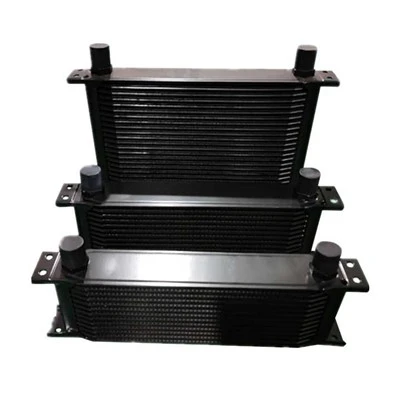
As an aluminum oil cooler supplier, I've had countless conversations with customers about what makes an oil cooler perform well. One of the most frequently asked questions is, "How does the size of an aluminum oil cooler affect its performance?" It's a fantastic question because the size can have a huge impact on how well the cooler does its job.
Let's start by understanding what an aluminum oil cooler does. In simple terms, it's a device designed to lower the temperature of the oil in an engine or a transmission. Whether you're dealing with a high - performance racing car or an industrial machine, keeping the oil at the right temperature is crucial. Overheated oil can lose its lubricating properties, which leads to increased wear and tear on engine components, reduced efficiency, and in severe cases, engine failure.
Surface Area and Heat Dissipation
The first and most obvious way size affects performance is through surface area. A larger oil cooler generally has more surface area. Why is surface area so important? Well, heat transfer occurs at the surface of the cooler. When the hot oil flows through the cooler, it comes into contact with the cooler's walls, and heat is transferred from the oil to the cooler. Then, the cooler dissipates this heat into the surrounding air.
Think of it like this: if you're trying to dry a wet towel, you'd want to spread it out as much as possible. The more surface area of the towel is exposed to the air, the faster it will dry. Similarly, a larger aluminum oil cooler with more surface area can transfer heat from the oil to the air more efficiently. This means that it can cool the oil more quickly and keep it at a lower temperature, even under high - load conditions.
For example, our Aluminum Plate Fin Air Oil Cooler is designed with a large number of plate fins. These fins significantly increase the surface area available for heat transfer. The more fins there are, and the larger the overall size of the cooler, the better it can dissipate heat and keep your oil temperature in check.
Fluid Flow and Pressure Drop
But size isn't just about surface area. It also affects fluid flow and pressure drop. When oil flows through an oil cooler, it has to navigate through a series of tubes or passages. A larger oil cooler might have wider or longer passages.
If the passages are too small, the oil will face a lot of resistance as it flows through the cooler. This is called high pressure drop. A high pressure drop means that the engine's oil pump has to work harder to push the oil through the cooler. This can put an extra strain on the pump and reduce the overall efficiency of the system.
On the other hand, a larger oil cooler with appropriately sized passages can allow for smoother oil flow. The oil can move through the cooler with less resistance, resulting in a lower pressure drop. This means that the oil pump doesn't have to work as hard, and the engine can operate more efficiently.
However, it's a delicate balance. If the passages are too large relative to the oil's flow rate, the oil might not spend enough time in the cooler to transfer a significant amount of heat. So, when designing an oil cooler, we have to carefully consider both the size of the cooler and the size of the internal passages to optimize fluid flow and heat transfer.
Cooling Capacity and Application
The cooling capacity of an oil cooler is directly related to its size. Cooling capacity refers to the amount of heat that the cooler can remove from the oil per unit of time, usually measured in watts or BTUs per hour. A larger oil cooler generally has a higher cooling capacity.
But the key is to match the size of the oil cooler with the application. For a small, low - performance engine, a large oil cooler might be overkill. It could be more expensive, take up more space, and potentially cause issues with fluid flow if the engine's oil pump isn't designed to push oil through a large - volume cooler.


On the other hand, for a high - performance engine, such as those found in racing cars, a small oil cooler won't be able to handle the heat generated. In racing applications, engines produce a lot of power, and with that comes a lot of heat. A large - sized Aluminum Racing Radiator with Oil Cooler is often necessary to ensure that the oil stays cool even during intense, high - speed races.
In industrial settings, the same principle applies. If you have a large machine with a high - demand hydraulic system, a larger oil cooler will be needed to maintain the proper oil temperature and prevent system damage.
Space and Installation Considerations
Apart from performance, the size of the oil cooler also affects its installation. In some applications, space is extremely limited. For instance, in a compact car engine bay, you might not have room for a large oil cooler. In such cases, you need to find a smaller cooler that can still provide adequate cooling.
Our company offers a range of sizes to accommodate different installation requirements. We understand that every customer has unique needs, and we're committed to providing solutions that fit both performance and space constraints. For example, our Auxiliary Radiator Tank Car Cooling System Coolant For Nissan is designed to be a compact yet effective addition to the car's cooling system, providing extra cooling capacity without taking up too much space.
Conclusion and Call to Action
In conclusion, the size of an aluminum oil cooler plays a vital role in its performance. From surface area and heat dissipation to fluid flow, pressure drop, cooling capacity, and installation, every aspect is affected by the size.
If you're in the market for an aluminum oil cooler, it's essential to carefully consider your specific application. We're here to help you make the right choice. Whether you need a small cooler for a compact engine or a large one for a high - performance machine, our team of experts can guide you through the selection process.
Don't hesitate to reach out to us for more information or to discuss your specific requirements. We're eager to work with you to find the perfect aluminum oil cooler solution for your needs.
References
- Incropera, F. P., DeWitt, D. P., Bergman, T. L., & Lavine, A. S. (2007). Fundamentals of Heat and Mass Transfer. Wiley.
- Cengel, Y. A. (2003). Heat Transfer: A Practical Approach. McGraw - Hill.