


More overseas buyers are sourcing aluminum radiators from China because the country combines a dense heat-exchanger supply chain, broad product coverage, flexible custom manufacturing, improving quality systems, and export-ready service. The strongest advantage is not simply a lower unit price. It is the ability to move from drawing or sample to tooling, testing, packaging, and repeat production within one connected manufacturing ecosystem.
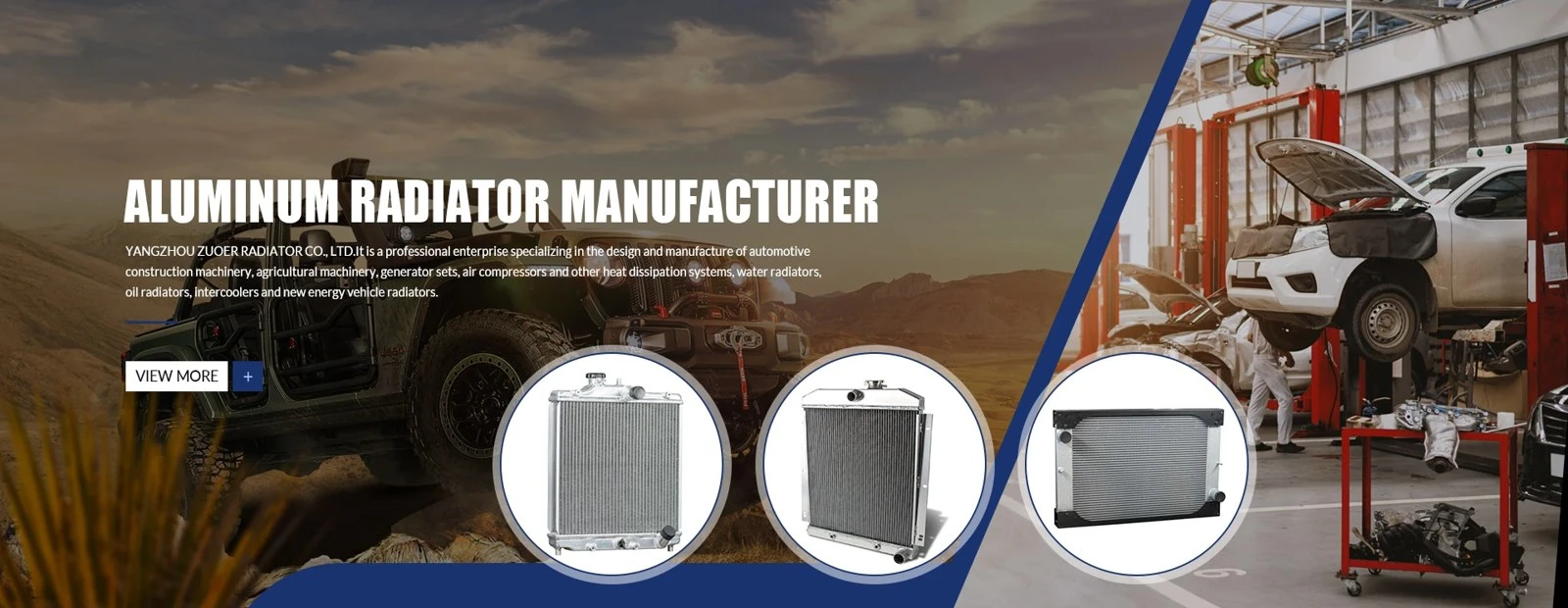
Why more buyers source aluminum radiators from China.
• China offers a wide supplier base, from large thermal-management groups to specialized aluminum radiator factories.
• Buyers can source passenger-car radiators, truck radiators, generator radiators, intercoolers, oil coolers, condensers, radiator cores, and custom heat exchangers from related supply networks.
• Custom projects can often start from drawings, samples, OE numbers, overall dimensions, core size, or application data.
• The real cost advantage appears when tooling, engineering changes, mixed SKUs, packaging, lead time, and logistics are evaluated together.
• Quality varies by supplier, so sample approval, test requirements, documentation, and first-shipment inspection remain essential.
The shift is about sourcing systems, not only price
For years, the simplest explanation for buying radiators from China was cost. That explanation is now incomplete. Unit price still matters, especially in competitive aftermarket and equipment programs, but experienced buyers increasingly look at the complete sourcing system: how quickly a supplier can understand an application, whether nearby vendors can support cores and tooling, how engineering changes are handled, and whether the factory can pack and document products for export.
Aluminum radiators are not isolated metal products. A finished assembly may depend on aluminum tubes, fins, headers, tanks, side plates, mounting brackets, filler necks, caps, hose connections, fans, shrouds, welding or brazing consumables, test equipment, cartons, foam protection, labels, and export logistics. In China, many of these capabilities are available within established automotive and industrial manufacturing clusters. A buyer can therefore work with one radiator manufacturer while that manufacturer coordinates a wider local network.
This connected structure is especially useful when a project is not a simple catalog purchase. A truck fleet may need a stronger mounting design. A generator-set builder may need a radiator matched to engine power and ambient conditions. An aftermarket distributor may need dozens of OE references in private-label cartons. The ability to coordinate those variations is one reason China aluminum radiator sourcing continues to attract B2B buyers.
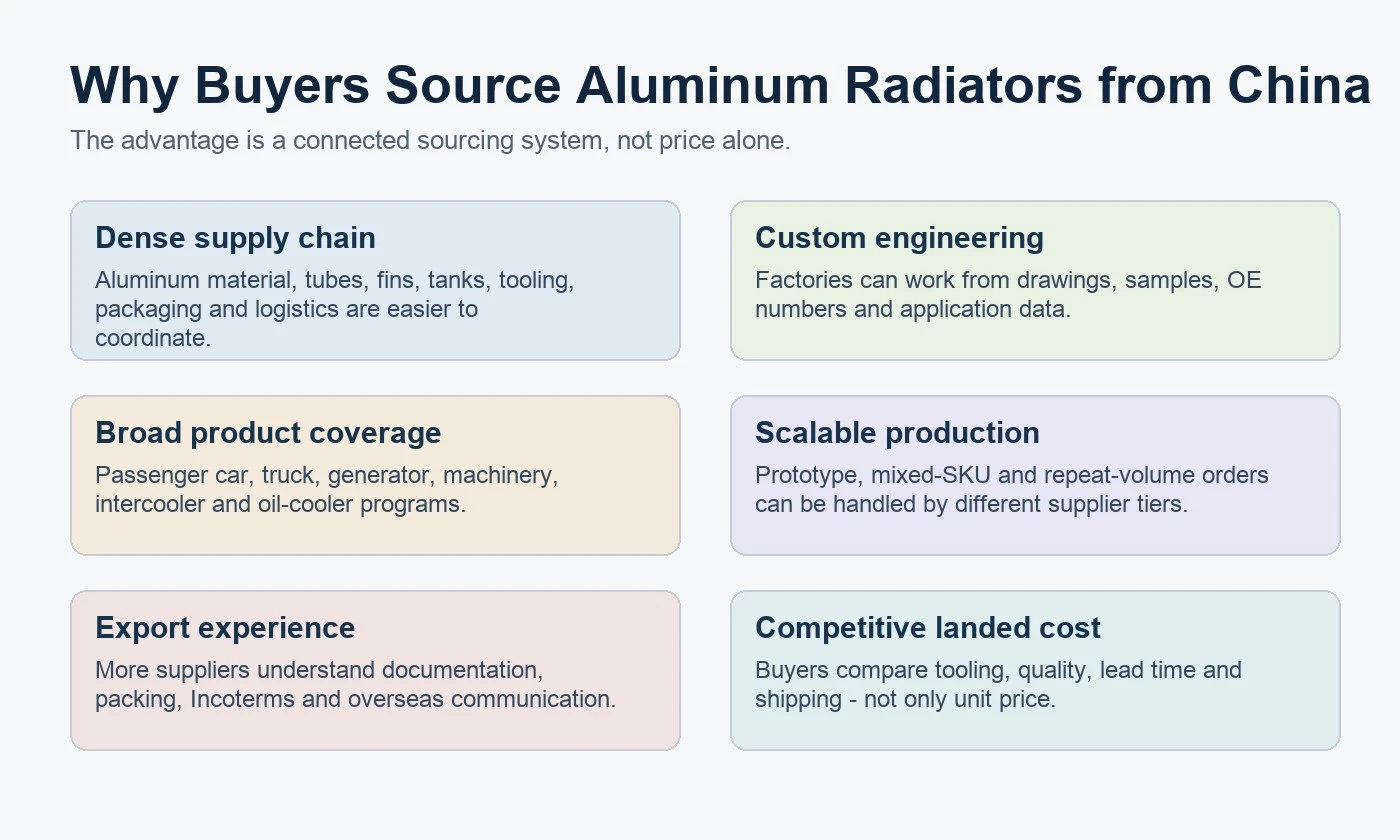
Key advantages of sourcing aluminum radiators from China.
A dense supply chain makes customization more practical
Customization is one of the clearest reasons buyers look for an aluminum radiator manufacturer in China. Many factories can discuss projects from a drawing, an old radiator, a physical sample, an OE number, or a set of installation dimensions. The supplier can then evaluate core size, tube and fin structure, inlet and outlet positions, mounting points, cap location, fan-shroud clearance, and connection details.
The important advantage is not that every factory can design every radiator. It is that the surrounding supply chain makes revisions more practical. Tooling vendors, aluminum component suppliers, welding and brazing resources, packaging suppliers, and machining services are often accessible without building an entirely new international vendor network. When a bracket moves, a tank changes, or a connection needs a different angle, the factory may be able to coordinate the change locally.
This flexibility supports several buyer groups. Replacement-parts distributors need broad model coverage and packaging options. Vehicle restoration and performance buyers may need low-volume all-aluminum radiators. Construction machinery and agricultural equipment companies may need stronger structures for dust, vibration, and long working cycles. Generator-set and industrial buyers may need a complete cooling package rather than a standard car radiator. Buyers can review Zuoer's aluminum radiator products and radiator product applications to see how one specialized supplier presents these different categories.
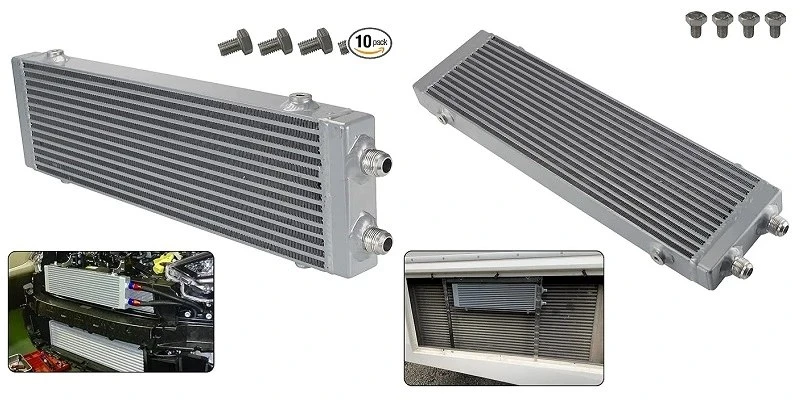
Aluminum radiator manufacturing and production processes in China.
Product breadth reduces supplier fragmentation
Another practical benefit is the breadth of related cooling products available from Chinese manufacturers. A buyer may begin with an automotive radiator and later need an intercooler, oil cooler, condenser, radiator core, fan shroud, or generator radiator. Sourcing these products from related factories can reduce the number of separate vendor-development projects.
This matters most for distributors and equipment manufacturers with mixed demand. A distributor may not want one container of a single radiator. It may need passenger-car references, truck radiators, condensers, and intercoolers packed under one brand program. An equipment builder may need different radiator sizes for several engine platforms. A supplier with broader radiator products and cooling solutions can make consolidation easier, although buyers should still verify capability for each product family instead of assuming that strength in radiators automatically means equal strength in condensers or oil coolers.
Product breadth also improves comparison. Buyers can ask whether the supplier uses shared inspection methods, whether packaging standards are consistent, and whether one engineering team controls related heat-exchanger products. These questions reveal more than a long product catalog.
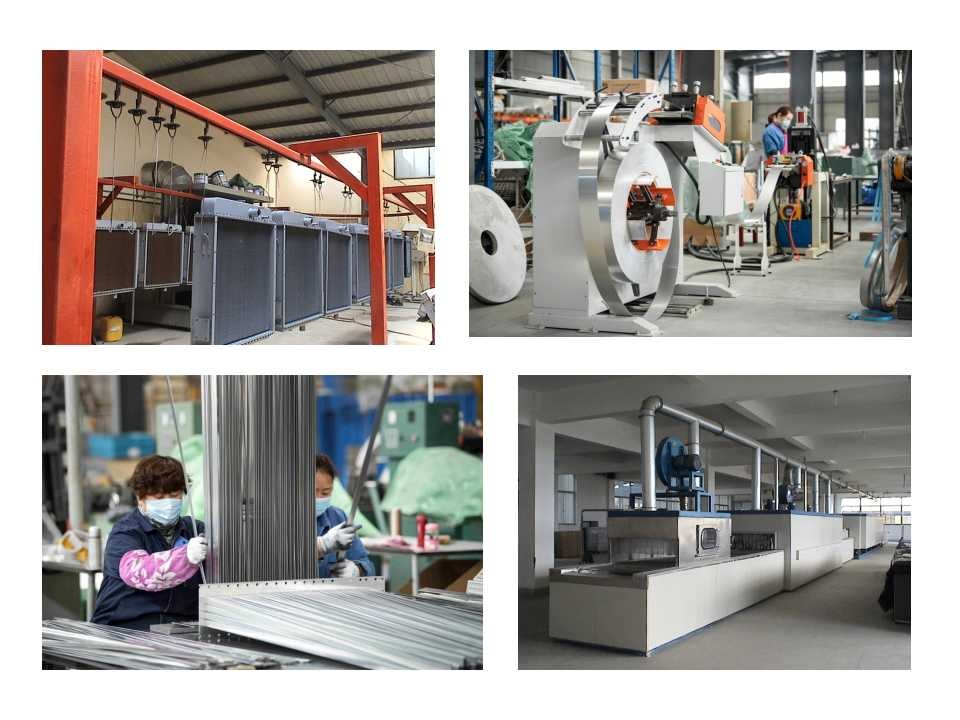
Custom aluminum radiator and intercooler product examples.
China can be cost competitive without reducing the decision to cheap labor
The most useful cost comparison is total landed cost, not the lowest quotation. A radiator with a low unit price can become expensive if it requires repeated samples, arrives with weak packaging, has incorrect mounting points, or creates high warranty claims. Chinese suppliers can be competitive because several cost factors work together: established production equipment, local component sourcing, available tooling services, production scale, and logistics experience.
The advantage is often strongest when buyers need a balance of custom work and repeat volume. Tooling and sample development may be more accessible than in high-cost manufacturing markets, while larger production runs can benefit from established brazing, welding, assembly, and testing lines. Mixed-SKU export experience can also improve container utilization for aftermarket buyers.
However, cost differences should always be normalized. Compare the same material specification, core dimensions, tube and fin design, pressure-test requirement, accessories, labeling, packaging, inspection level, Incoterm, and warranty basis. The International Chamber of Commerce maintains the official Incoterms rules used to define responsibilities in international trade. A quotation on EXW terms is not directly comparable with one on FOB or CIF terms unless the missing transport and handling costs are added.
|
Buyer priority |
Why China can be attractive |
What still needs verification |
|
Custom development |
Local tooling and component networks can support revisions |
Drawing control, engineering assumptions, sample approval |
|
Product range |
Many related radiator and heat-exchanger categories |
Actual in-house capability for each product family |
|
Cost |
Scale, local sourcing and export experience can lower total cost |
Material, testing, packaging, Incoterm and warranty basis |
|
Lead time |
Established production and supplier clusters can shorten coordination |
Tooling schedule, capacity, holidays and shipping route |
|
Quality |
More factories provide documented inspection and testing |
Certificate scope, test method, traceability and batch records |
|
Export service |
Private label, mixed SKU, packing and freight experience |
Communication, documents, damage prevention and claims process |
Quality control has become more visible and buyer-driven
Many overseas buyers no longer accept a general statement such as quality is good. They ask for a defined inspection process. Chinese radiator suppliers that work with export customers increasingly respond with material checks, dimensional inspection, leak or pressure testing, visual inspection of welds or brazed joints, fit checks, packaging confirmation, and shipment records.
The presence of equipment or certificates is not enough by itself. Buyers should ask how requirements are translated into production controls. What pressure is used for the leak test? Is every unit tested or only a sample? Which dimensions are treated as critical? How are nonconforming products isolated? Are test records linked to a batch? How are packaging changes approved? These questions distinguish a functioning quality process from a marketing page.
Quality-management frameworks can support the discussion. ISO explains that ISO 9001 provides a quality management framework, while automotive programs may also reference IATF 16949 requirements where relevant. Buyers should request current certificates and confirm that the scope and manufacturing location match the quoted product. A certificate should support supplier evaluation, not replace sample testing and process verification.
From a factory perspective, the best projects are usually the ones with clear acceptance criteria before production. When the buyer defines fit, dimensions, pressure, appearance, packaging, and documents at the quotation or sample stage, the factory has a more stable target and both sides reduce avoidable disputes.
Faster iteration helps when specifications are incomplete
Radiator sourcing often begins with imperfect information. The buyer may have an old part but no drawing. It may know the engine model but not the required cooling capacity. It may have overall dimensions but not the internal core construction. A supplier that can turn incomplete inputs into a structured list of questions creates real value.
Chinese export factories have become accustomed to working with photos, samples, OE references, CAD files, and messaging-based clarification. This can shorten the path to a usable quotation, especially for replacement and special-application projects. Time-zone differences can even support an overnight review cycle when both parties organize questions clearly.
Speed must still be controlled. A fast quotation is not the same as a correct engineering answer. Buyers should look for suppliers that pause when information is missing, mark assumptions, issue revised drawings, and obtain sample approval before bulk production. Zuoer's guide to what information buyers should provide before ordering a custom radiator is useful because it turns an informal inquiry into a technical package.
Export service and communication are part of the product
A radiator may pass a factory test and still fail as an international order if documents, labeling, packaging, or communication are weak. This is why experienced buyers increasingly evaluate export service as part of supplier capability. They want clear quotations, realistic lead times, packaging photos, carton marks, packing lists, commercial invoices, certificates when required, and a defined response if a shipment problem appears.
China's long participation in automotive parts and machinery exports has created a large group of suppliers familiar with private labeling, palletization, mixed containers, freight forwarders, and different delivery markets. The level of service still varies widely, but buyers have more choice than they did when only a small number of factories communicated directly with overseas customers.
Communication quality is easy to test before placing an order. Send the same inquiry to several manufacturers. The strongest responses normally summarize the application, identify missing information, separate confirmed facts from assumptions, and provide a clear next step. A supplier that only sends a price without checking the radiator specification may be fast, but it may also be transferring technical risk back to the buyer.
When sourcing from China may not be the best answer
China is not automatically the best source for every radiator project. Very small emergency orders may be better purchased from local stock. A vehicle program with strict local-content rules may require a regional supplier. Projects that need daily on-site engineering support may benefit from manufacturing closer to the assembly plant. High tariffs, anti-dumping measures, or unusually expensive freight can also change the landed-cost calculation.
The supplier base is large, which is both an advantage and a risk. Some companies are true manufacturers, some outsource part of production, and some operate mainly as trading companies. Product photos and certificates can be outdated. Similar-looking radiators can use different material thicknesses, internal structures, or test standards. A buyer who selects only by price can receive a product that looks correct but does not perform consistently in the intended environment.
The right question is therefore not whether Chinese radiators are good or bad. It is whether a specific supplier, factory, process, and product are suitable for the specific application. Good sourcing replaces country-level assumptions with supplier-level evidence.
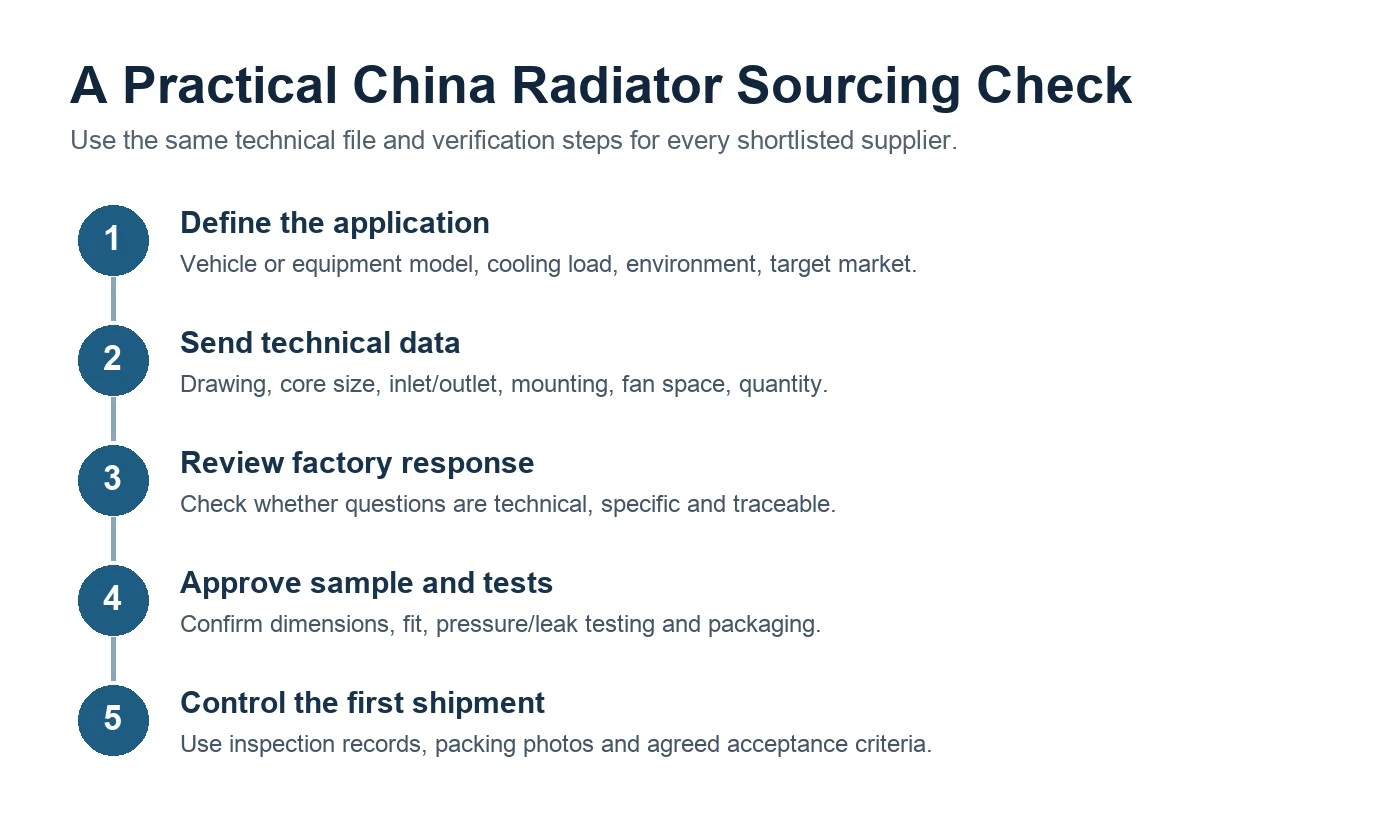
Five steps for verifying a China aluminum radiator supplier.
A five-step way to reduce sourcing risk
Step 1: Define the application. Record the vehicle or equipment model, engine information, operating environment, target market, expected quantity, and whether the need is replacement, custom development, or a new equipment program.
Step 2: Prepare technical inputs. Send a drawing or sample when possible. Include overall dimensions, core size, inlet and outlet layout, hose diameter, mounting structure, cap or tank details, fan-shroud space, and any known pressure or performance requirements.
Step 3: Compare supplier questions, not only prices. A capable aluminum radiator factory should identify missing data and explain what must be confirmed before tooling or production. Compare response quality, drawing control, sample plan, lead time, MOQ, and packaging proposal.
Step 4: Approve the sample and test method. Check fit, dimensions, workmanship, leak or pressure testing, packaging, and documentation. When the application is demanding, consider independent testing or third-party inspection.
Step 5: Control the first shipment. Agree on inspection criteria, labeling, carton marks, pallet method, spare parts, and photo records. Review the first production lot carefully before treating the supplier as fully qualified.
What the trend means for B2B buyers
The growing preference for sourcing aluminum radiators from China is not a guarantee that every project will be cheaper, faster, or better. It reflects a broader change: buyers can access a mature supplier ecosystem that supports catalog products, custom engineering, related cooling components, export packaging, and repeat production at several scales.
For procurement teams, this creates leverage. They can compare large thermal-management companies with specialized radiator manufacturers, choose between existing tooling and custom development, and build a supply plan around product risk rather than brand recognition alone. The winners are buyers who use that choice carefully: clear specifications, controlled samples, documented tests, and realistic landed-cost comparisons.
Yangzhou Zuoer Radiator Co., Ltd. states that it operates an aluminum radiator production line and has annual capacity of more than 300,000 radiator products. Buyers considering automotive, truck, generator, machinery, or custom cooling projects can review the company's aluminum radiator manufacturer profile and send radiator specifications, drawings, samples, or application details for a technical review.
Frequently asked questions
Are aluminum radiators from China always cheaper?
Not always. China is often cost competitive, but the result depends on material specification, tooling, order volume, testing, packaging, freight, tariff, Incoterm, and warranty risk. Compare total landed cost on the same technical basis.
Can Chinese factories make custom aluminum radiators?
Many can work from drawings, samples, OE numbers, dimensions, and application information. Capability varies, so confirm design responsibility, tooling ownership, sample process, critical dimensions, and test requirements before production.
How can buyers check the quality of a China radiator supplier?
Review the factory identity, current certificates, sample quality, material details, leak or pressure test method, inspection records, packaging, and first-shipment controls. Third-party inspection can be useful for new or high-risk programs.
What information should be included in an RFQ?
Include application, vehicle or engine model, drawing or photos, overall and core dimensions, inlet and outlet positions, mounting points, fan-shroud space, quantity, target market, packaging, delivery terms, and required tests.
Is China suitable only for automotive aftermarket radiators?
No. Chinese suppliers serve aftermarket, truck, generator-set, construction machinery, agricultural equipment, industrial cooling, intercooler, oil-cooler, condenser, and custom heat-exchanger projects. The supplier should be selected according to the application.
What is the biggest sourcing mistake?
Choosing from price and product appearance alone. Two radiators can look similar while using different materials, structures, tests, or packaging. Technical confirmation and sample approval should come before bulk purchasing.


